
Ventilator Intensive
Do you want to become more comfortable with ventilators?
A four-week practical Intensive for clinicians who want to better understand mechanical ventilation, make sense of what they see at the bedside, and make better clinical decisions.
Flexible online learning
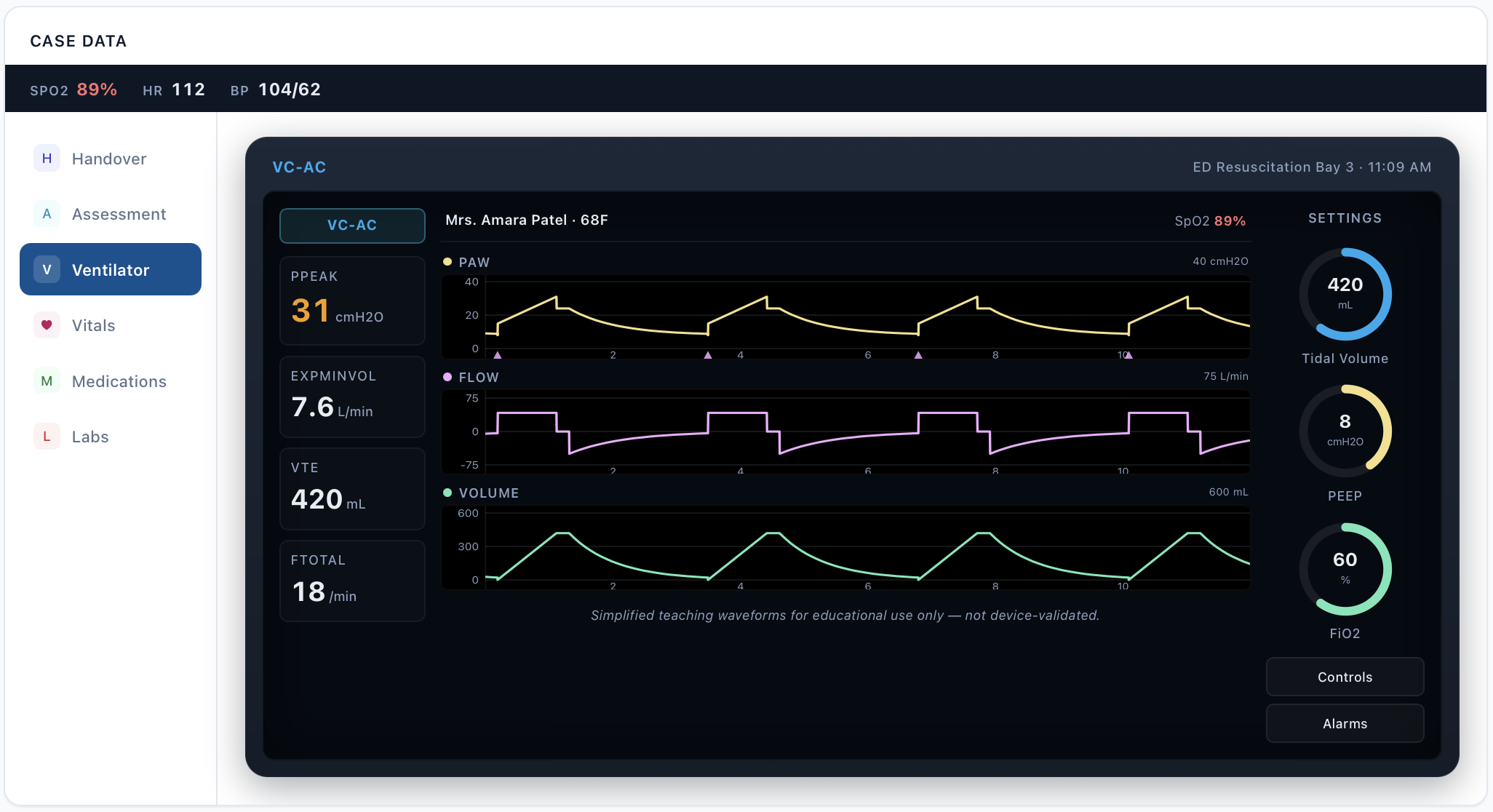
Ventilator Simulator
Live sessions with ventilator experts
365-day access
What You Learn
READ THE SCREEN
Understand settings, monitored values, pressures, volumes, modes
FOLLOW THE CLINICAL PICTURE
See who is doing the work and how the patient and ventilator are working together.
IDENTIFY PROBLEMS
Differentiate oxygenation from ventilation problems and connect the findings to the underlying physiology.
KNOW WHAT TO DO NEXT
Work through interventions, changing patient conditions and common ventilator alarms.
-
We start by getting oriented. What is actually set on the ventilator? What is the patient actually receiving? And which numbers deserve your attention?
We’ll break down ventilator settings and monitored values, oxygenation versus ventilation, ABGs, FiO₂, PEEP, respiratory rate, tidal volume, minute ventilation, pressures, and the basic information sitting in front of you on the ventilator screen.
You’ll also start using the Ventilator Simulator with rapid-fire cases that ask you to make one important call: oxygenation problem, ventilation problem, or both?
Simulator: Oxygenation and Ventilation Drills -
Now we look at how the patient and ventilator actually work together.
Who started the breath? Who is doing the work? What support is the ventilator providing? What happens when the patient stops breathing? And what can pressures and waveforms tell you about what is happening breath to breath?
We’ll work through triggering, spontaneous and mandatory breaths, common modes, pressure and volume, work of breathing, backup ventilation, peak versus plateau pressure, basic waveforms, and common patient-ventilator asynchrony.
The goal is not to memorize every mode on every ventilator. It is to understand the mechanics underneath them.
Simulator: Ventilator Support Lab
Live session: Clinical cases and Ventilator modes
-
This is where we move from reading the ventilator to making decisions.
We’ll work through patients with oxygenation problems, ventilation problems, and changing respiratory physiology. You’ll explore how FiO₂, PEEP, respiratory rate, tidal volume, and other changes affect the patient, including what can happen elsewhere in the body when you change ventilator support.
We’ll also get into lung-protective ventilation, predicted body weight, airway pressures, air trapping and auto-PEEP, and why the right intervention depends on understanding the problem you are actually trying to solve.
Then you’ll put it together in full clinical cases where your decisions change what happens next.
Simulator: Intervening Clinical Cases
-
WEEK 4: WHEN THE VENTILATOR STARTS YELLING
Alarms are where everything from the previous three weeks comes together.
We’ll work through high-pressure and low-pressure alarms, sudden deterioration, airway obstruction, secretions, changing resistance and compliance, circuit problems, pneumothorax, and other reasons a previously stable ventilated patient might suddenly look very different.
Most importantly, we’ll practise a systematic approach that starts with the patient rather than the alarm: Is the patient stable? What changed? Is it the patient, the tube, or the machine?
The Intensive finishes by bringing the ventilator back into the bigger clinical picture. Trends, disease progression, hemodynamics, sedation, metabolic demand, and the patient's overall clinical course all influence what you see on the screen.
Live session: Clinical Cases and Putting It Together
Simulator: Alarm Management
How You Learn
-
Work through short, flexible online learning built around practical clinical problems.
-
Use our Ventilator Simulator to work through rapid-fire drills, patient cases and ventilator alarms with immediate coaching feedback (see below)
-
Join live online sessions with expert ventilator clinicians to work through cases, ask questions and make sense of the difficult parts.
When You Learn
October 2026 Cohort
Dates
September 25, 2026 - October 16, 2026
Live Sessions
Week 2
September 29
0900-1000 PST
Week 4
October 16
0900-1000 PST
Price
$400.00 CAD / seat
November 2026 Cohort
Dates
November 2, 2026 - November 27, 2026
Live Sessions
Week 2
November 13
1000-1100 PST
Week 4
November 25
1000-1100 PST
Price
$400.00 CAD / seat
January 2027 Cohort
Dates
January 4, 2027 - January 31, 2027
Live Sessions
Week 2
January 13
0900-1000 PST
Week 4
January 27
0900-1000 PST
Price
$400.00 CAD / seat